
Click here for FurtherInquiry:http://www.pioneerherbal.com/natural-extracts/bambusa-arundinacea%20.html
Botanical Name : Bambusa Arundinacea
Sanskrit name : Vamsah, Venuh
English Name : Thorny bamboo
Family: Gramineae
Part Used: Bamboo leaves, Bamboo Exudate, Banshalochan, Tabasheer
Description of
Bambusa Arundinacea :
A tall thorny bamboo upto 30 m in height with many sterns, tufted on stout root stock, nodes prominent, the lowest rooting, internodes upto 45 cm long, stem sheath coriaceous, orange-yellow, streaked, glabrous or puberulous beneath, base rounded, ciliate, tip stiff, midrib narrow, leaf sheaths with a short bristly auricle, ligule short; spikelets glabrous, yellow or yellowish green, in very long panicles, often occupying the whole stem, floral glumes, 3-7 in number, the uppermost 1-3 male or neuter, lodicules 3, hyaline, 1-3 nerved, ciliate; fruits oblong grains, beaked by the style base, grooved on one side.
A tall thorny bamboo upto 30 m in height with many sterns, tufted on stout root stock, nodes prominent, the lowest rooting, internodes upto 45 cm long, stem sheath coriaceous, orange-yellow, streaked, glabrous or puberulous beneath, base rounded, ciliate, tip stiff, midrib narrow, leaf sheaths with a short bristly auricle, ligule short; spikelets glabrous, yellow or yellowish green, in very long panicles, often occupying the whole stem, floral glumes, 3-7 in number, the uppermost 1-3 male or neuter, lodicules 3, hyaline, 1-3 nerved, ciliate; fruits oblong grains, beaked by the style base, grooved on one side.
Click here for FurtherInquiry: http://www.pioneerherbal.com/natural-extracts/bambusa-arundinacea%20.html
Chemical Constituent:
Analysis of tender shoots gave protein, carbohydrates, calcium, phosphorus, iron, magnesium, sodium, copper, chlorine, thiamine, vitamin-C etc.
Analysis of tender shoots gave protein, carbohydrates, calcium, phosphorus, iron, magnesium, sodium, copper, chlorine, thiamine, vitamin-C etc.
Medicinal Uses:
1. It is used in diarrhoea, dyspepsia, flatulence and worm problems.
2. It is used in fever, inflammations, ulcers and wounds.
3. It is also used in vomiting, hyperdipsia and burning sensation.
4. It helps to cure cough, bronchitis, asthma, asthmatic bronchitis and emphysema.
5. It is used in strangury, syphilis, ophthalmia and haemorrhages.
1. It is used in diarrhoea, dyspepsia, flatulence and worm problems.
2. It is used in fever, inflammations, ulcers and wounds.
3. It is also used in vomiting, hyperdipsia and burning sensation.
4. It helps to cure cough, bronchitis, asthma, asthmatic bronchitis and emphysema.
5. It is used in strangury, syphilis, ophthalmia and haemorrhages.
Folk Medicine
An ointment from the root is said to be a folk remedy for cirrhosis and hard tumors, especially tumors of the abdomen, liver, spleen and stomach (Hartwell, 1967–1971). Tabasheer, a siliceous secretion (up to 97% SiO2), considered aphrodisiac, cooling, and tonic, is used in asthma, cough and debilitating diseases (C.S.I.R., 1948–1976). Leaves given to horses suffering coughs and colds.Chemistry
The stem consists almost entirely of cellulose and hemicellulose (xylans, arabans, polyuronides, etc.) and lignins, with a small amount of resins. Oven-dried stems contain 3.3% ash, 1.8% silica, 6.0% hot water solubles (see above), 19.6% pentosans, 30.1% lignin, and 57.6% cellulose. Analyses from paper pulping showed 8.5% water extract, 1.2% fat, wax, etc., 24.4% pectose, 15.6% lignin, 50.3% cellulose, and 1.6% ash. Per 100 g, the seeds are reported to contain 11.0% H2O, 11.8 g protein, 0.6 g fat, 75.4 g total carbohydrate, 1.7 g fiber, and 1.2 g ash (C.S.I.R., 1948–1976). On a zero moisture basis the fresh leaves (57.1% DM) contain 18.6% CP, 24.1% CF, 11.8% ash, 4.1% EE, 41.4% NFE. With sheep the CP exhibits 72.4% digestibility, CF 49.1%, EE 10.8%, and NFE 48.8% (Gohl, 1981). Per 100 g, the shoot is reported to contain 29 calories, 90.7 gH2 0, 2.3 g protein, 0.2 g fat, 6.6 g total carbohydrate, 0.5 g fiber, 0.7 g ash, 33 mg Ca, 41 mg P, 0.4 mg Fe, 20 meg b-carotene equivalent, 0.15 mg thiamine, 0.7 mg riboflavin, 0.6 mg niacin, and 4 mg ascorbic acid.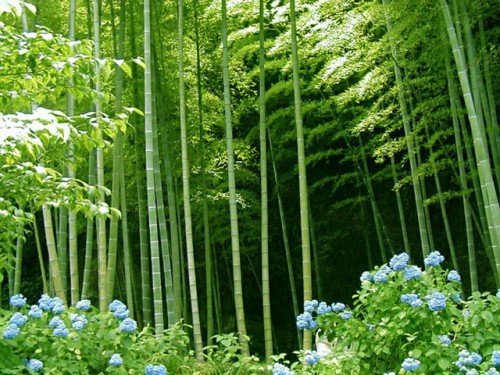
Toxicity
Eight grams of raw shoots or slightly more improperly cooked shoots can cause death. Young shoots contain 0.03% HCN (C.S.I.R., 1948–1976). Hairs on various bamboos, and fungi which live thereon, may cause dermatitis (Mitchell and Rook, 1979). Benzoic acid and traces of cyanogenic glucoside present in shoots have lethal effect on mosquito larvae (has antiseptic and larval properties).Click here for FurtherInquiry: http://www.pioneerherbal.com/natural-extracts/bambusa-arundinacea%20.html
Description
Tall woody bamboo, stems thorny, numerous, tufted, up to 40 m tall, curving at top; branches numerous, internodes 30–45 cm long, prominent, bearing in lower parts of stems dense half whorls of stiff, naked, horizontal branches, armed with 2–3 recurved, stout spines; lowest nodes rooting; stem-sheaths leathery, orange-yellow when young, hairy outside, shining and ribbed inside, 30–45 cm long; blade triangular, glabrous, covered with a brown felt of bristly hairs inside; leaves thin, linear, up to 20 cm long, glabrous above, hair beneath; leaf-sheaths hairy, small; inflorescence an enormous panicle, often occupying the entire stem; branchlets loose clusters of pale, glabrous spikes.Germplasm
Reported from Asian Centers of Diversity, bamboos are reported to tolerate insects, laterites, low pH, slope, and weeds (2n = 72, 70) (Duke, 1978).Distribution
Wild in most parts of tropical India and Pakistan, growing up to 1000 m altitudes in the Nilgiris and hills of southern India; north into China.Ecology
Probably ranging from Subtropical to Tropical Very Dry to Wet Forest Life Zones, spiny bamboo probably tolerates annual precipitation of ca 6 to 40 dm, annual temperature of ca 18 to 29°C, and pH of 4.3 to 7.3. Thrives in tropical to subtropical climates, growing in warm humid temperate areas as well, but thriving best under frost-free conditions, in rich to medium fertile soils with good water supply.Cultivation
Bamboos may be produced by means of seeds, vegetative portions or by layering the stems and letting them root at the nodes. Seeds are sown in soil about 0.6 cm deep and about 2.5 cm apart in rows 7.5–10 cm apart. Germination occurs in about a week and seedlings grow rapidly. When plants are 15–20 cm tall, they are transplanted to individual containers. Transplanting to the field is done when plants are about 1 m tall. Growing plants from seed is the most economical and convenient method of propagating large numbers of plants. Clump division is the traditional and most generally prevalent method of propagating bamboos vegetatively. Active growth of young shoots from buds on the rhizome in this group of bamboos is initiated during the summer. The commonly recommended practice is to process vegetative propagules just before the initiation of growth of these buds. A clump is divided into two equal parts, retaining the root system, branches and leaves of each part as fully intact as possible. Properly set out, these propagules usually give the highest degree of success. Clump divisions taken from the edge of the clump are apt to give superior results. The rhizome should be severed at one point only, at the neck of the oldest rhizome axis in the propagule. Cut should be made at the slender neck where the minimum damage to the rhizome is done. Roots are best preserved and protected keeping them in a ball of earth when the propagule is taken from the parent plant. Some species, as B. tulda, has been successfully propagated by rhizomes planted in situ, with 95% survival not uncommon. Culm segments, with one or more nodes, bearing buds or branches, are used widely as a means of propagation in both the Old and New World. Branches are usually pruned to 30 cm or less, with no foliage retained. Such cuttings are set upright or at an angle, with at least one node well covered. B. vulgaris is often propagated this way.Click here for FurtherInquiry: http://www.pioneerherbal.com/natural-extracts/bambusa-arundinacea%20.html
Harvesting
Bamboos are harvested for food when the young shoots are 30–75 cm tall. Other parts of the plant are harvested whenever needed, as the leaves, branches and woody stems.Yields and Economics
Finding no published data, I estimate the yields in excess of 10 MT DM/ha/yr. One of the most useful group of plants in the tropics, bamboos are used as food for man and fodder for livestock, for building materials, for weaving and cordage, for paper pulp and for making all types of utensils. Bamboos are very important in the economy of Oriental peoples; millions are occupied in growing and producing raw bamboo, and manufacturing of bamboo products.Energy
New culms start growing slowly, growth soon approaching 30 cm/day with 75 cm having been recorded in one day in Sri Lanka. In Trinidad, Bambusa vulgaris produced more than 10 MT pure dry cellulose pulp per hectare per year on a three-year cutting cycle. The culms of B. arundinacea are said to be considerably more durable than those of B. vulgaris. With sheep, the ME of the leaves is 1.77 megacalories per kg dry weight.Biotic Factors
Few serious diseases or pests of bamboos are reported. Bamboo borers can be problematicalToxicology:
No toxic effect was seen on human body with its consumption.
Uses :The leaves are sweet, astringent, cooling, emmenagougue, opthalmic, vulnerary, constipating and febrifuge. Bamboo leaves contain the highest protein levels, stems have less.The bamboo resin (Tabasheer, Banshalochan) is the Siliceous secretion found in the internodes of the stems of various species of Bamboo. It occuors in fragments of masses, and is translucent or transparent and bluish white color. It is astringent, acrid, sweet, cooling, expectorent, constipating, cardiotonic, haemostatic, aphrodisiac, diuretic.
Click here for FurtherInquiry: http://www.pioneerherbal.com/natural-extracts/bambusa-arundinacea%20.html
*Disclaimer
"These statements have not been evaluated by the food and drug administration or any other regulatory body. These products are not intended to diagnose, treat, cure, or prevent any
disease.

ReplyDeleteAAKASH is a leading bamboo biomass renewable energy company engaged in bamboo plantation and creating sustainable environment friendly sources of energy for the use of mankind bamboo energy company in srilanka
Nice article, thank you for sharing useful information, also find bamboo energy company in srilanka
ReplyDelete